Agricultural Fencing

    Fixed-Knot & Game Fence

    Published specifications for fixed-knot woven wire: 49 in standard through 8 ft game heights, 9 horizontal wires, 3 in / 6 in / 12 in stay spacing, 330 ft rolls and a 30–40 year service life.

    • Operating since 2015
    • Family-owned & woman-owned
    • BBB A+ Accredited
    • Blue Book ProView Verified

    General liability and Workers’ Compensation carried — COIs on request. See full prequalification and contractor credentials.

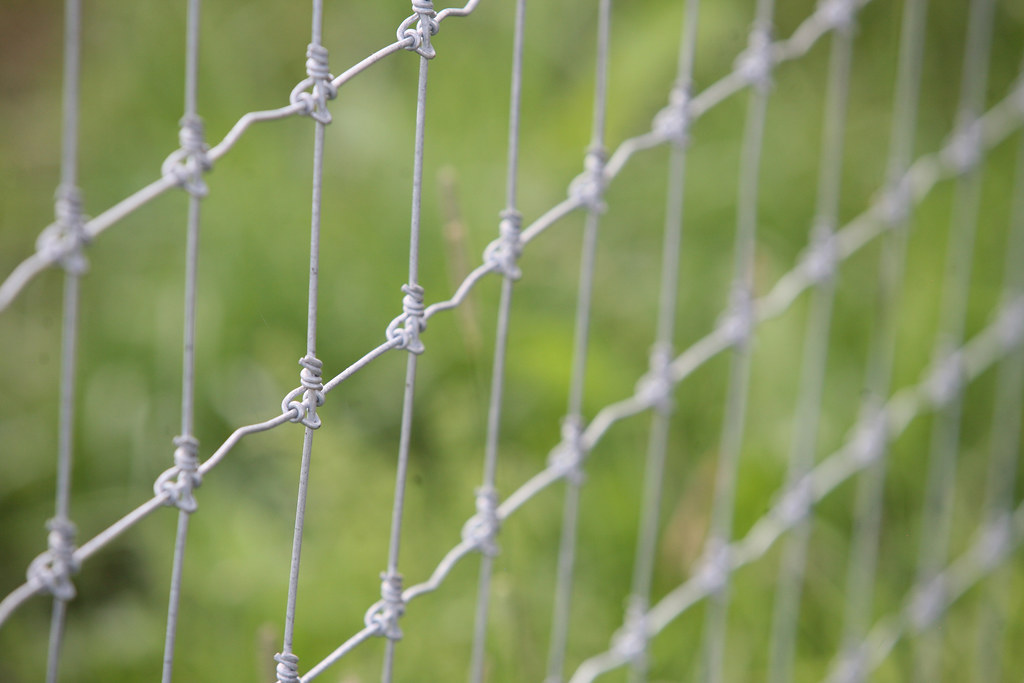
    Close-up of fixed-knot woven wire fence mesh showing the knot wire locking each vertical stay to the horizontal line wires
    Illustrative — product example, not an S&S Fencing project.

    What fixed-knot fence is and what it is for

    Fixed-knot fence is woven wire in which a separate wire knot locks each vertical stay to each horizontal line wire, so the mesh holds its shape under animal impact instead of collapsing — which is why it is the standard for mixed livestock, high-pressure pastures and deer or game exclusion.

    The knot is the whole argument. A hinge-joint fence uses a wrapped vertical that pivots when it is hit; once it pivots, the mesh opening changes permanently and the fence starts to sag and bag. A fixed knot does not pivot, so the fence you inspect in year twenty has the same aperture it had on day one.

    • Mixed livestock — cattle, goats, sheep and horses on the same perimeter.
    • Rough terrain — the mesh conforms to grade without losing geometry.
    • Game exclusion and containment — 8 ft heights for deer and game; see deer and game fence.
    • Predator pressure — tight bottom stays keep coyotes and dogs out of small stock.

    Published specifications

    Standard fixed-knot livestock fence is 49 in tall with 9 horizontal wires, moving to 54–60 in for bulls and 8 ft for deer and game, supplied in 330 ft rolls.

    ItemSpecification
    ConstructionFixed knot — separate knot wire locks each stay to each line wire
    Standard height49 in general livestock
    Bull and heavy stock54–60 in
    Deer and game96 in (8 ft), single roll or stacked
    Horizontal wires9 wires typical at 49 in; more on taller rolls
    Stay spacing12 in general purpose · 6 in mixed and small stock · 3 in predator and game exclusion
    Wire12.5 gauge high-tensile line wires, hard-drawn
    CoatingClass 3 galvanized standard; Class 40 / Bezinal for wet or high-ammonia sites
    Roll length330 ft
    Line post spacing12–20 ft depending on height, terrain and pressure
    Service life30–40 years

    Stay spacing decides what the fence excludes

    12 in stays are a cattle and general livestock fence. 6 in stays hold goats, sheep and foals. 3 in graduated stays are what you specify when the fence has to stop predators or hold game — the tighter bottom of the roll is placed at ground level and the openings widen toward the top.

    Installation method

    Fixed-knot fence is stretched, not stapled loose: braced end assemblies go in first, the roll is tensioned as a unit against those braces, and only then is it fastened to line posts.

    • Braced ends. Two posts 8 ft apart at 4 ft embedment, horizontal compression member and diagonal tension wire — the same assembly used on high-tensile fence, sized up for the surface area of a tall roll.
    • Driven line posts. We drive posts rather than hand-set them wherever soil allows, so the post holds in compacted soil instead of backfill.
    • Stretching. The roll is pulled with a stretcher bar across the full height so tension is even top to bottom; uneven stretching is what leaves a wavy top wire.
    • Terrain following. On grade, post spacing tightens and the mesh is contoured to the ground. Dips get tie-downs; crowns get an intermediate braced post.
    • Water gaps. Crossings are built as separate breakaway panels so a flood takes the gap and not 300 ft of fence.
    • Top and bottom protection. Barbed or smooth top wire and a tight ground line where pressure or predators require it.

    Fixed-knot compared to the alternatives

    Fixed-knot woven wire carries the longest service life of any wire farm fence at 30–40 years, roughly double barbed wire, and it is the only wire system that holds a stable mesh opening for its whole life.

    SystemService lifeHolds mesh shapeBest for
    Fixed-knot woven wire30–40 yearsYes — knot does not slipMixed livestock, game, predators, rough ground
    Hinge-joint woven wire15–25 yearsNo — vertical pivots on impactLow-pressure boundary fence
    Barbed wire15–20 yearsn/aCattle-only perimeter, lowest first cost
    High-tensile smooth wire20–30 yearsn/aLong runs, electrified grazing systems
    Kentucky board fence20–30 years with paintingn/aPresentation, horse turnout, entrances

    Maintenance and expected lifespan

    A Class 3 fixed-knot fence should give 30–40 years with almost no annual maintenance beyond keeping brush off the wire and checking brace assemblies once a year.

    • Annually — walk the line, check diagonals on braced ends, clear brush and volunteer trees.
    • After storms — reset breakaway water-gap panels.
    • Never — no annual re-stretching, which is the practical difference from hinge-joint fence.
    • Warranty work — S&S covers workmanship on fences we installed for one year; we do not take on repairs to other contractors’ fences.

    Total cost of ownership per year of service

    Fixed-knot costs more per foot than barbed wire and less per year of service, because 30–40 years of life against 15–20 cuts the annualized cost roughly in half.

    Add the labor you do not spend re-stretching, the stock you do not lose through a bagged fence, and the second rebuild you avoid inside a 40-year horizon, and fixed-knot is the cheapest livestock perimeter available in Kentucky over the life of the asset.

    Installed pricing varies with height, stay spacing and how much clearing the line needs, so it is quoted after a walk. Call 502-468-1209.

    Warranty and proof

    Every fixed-knot installation carries the S&S one-year workmanship warranty, backed by General Liability and Workers’ Compensation coverage with COIs on request.

    Family-owned and woman-owned since 2015, headquartered in Cox’s Creek, Nelson County, Kentucky. BBB A+ Accredited and Blue Book ProView Verified. Full documentation is on the credentials page.

    References are provided on request. See more in the projects gallery.

    How We Work

    Our Process

    1. Step 1

      Walk and specify

      Height, stay spacing and coating class are chosen against your livestock class and pressure level, then written down.

    2. Step 2

      Clear and lay out

      Line cleared, corners and ends staked, water gaps and crossings identified before any post goes in.

    3. Step 3

      Braced ends, driven posts

      Braced assemblies built first; line posts driven for compacted holding power rather than hand-set in backfill.

    4. Step 4

      Stretch and hand off

      Roll stretched evenly full-height, fastened, gaps built, and the finished line walked with you.

    Frequently Asked Questions

    In fixed-knot fence a separate knot wire locks each vertical stay to each horizontal line wire so the mesh cannot change shape. In hinge-joint fence the vertical wraps around the horizontal and pivots under impact, which permanently deforms the opening and leads to sagging. That single difference is why fixed-knot lasts 30 to 40 years and hinge-joint typically lasts 15 to 25.
    Deer and game exclusion fence should be 8 ft (96 in) tall. General livestock fixed-knot fence is 49 in, and 54 to 60 in is specified for bulls and heavy stock. Anything under 8 ft will be jumped by whitetail deer under pressure.
    12 in stays suit cattle and general livestock, 6 in stays hold goats, sheep and foals, and 3 in graduated stays are used where predators or game must be excluded. Graduated rolls place the tightest spacing at ground level where pressure is highest.
    Fixed-knot woven wire is supplied in 330 ft rolls. Roll length matters for planning brace placement, because a fence is stretched roll by roll between braced assemblies.
    A Class 3 galvanized fixed-knot fence lasts 30 to 40 years in Kentucky conditions, compared with 15 to 20 years for barbed wire. Class 40 or Bezinal zinc-aluminum coating extends that further in wet or high-ammonia environments such as barn lots and feed areas.
    Fixed-knot fence with a 2 in by 4 in aperture is safe for horses because the opening is too small for a hoof to pass through and become entrapped. Larger-aperture game fence is not appropriate for horse turnout; use 2 in by 4 in no-climb woven wire or board fence there.

    Send us the drawings and the spec section

    We bid from plans, walk the site, and return a line-item scope. Ask Shawn or Shelby Fick directly at 502-468-1209.

    Also See

    Related Scopes & Documentation

    Family-Owned · Woman-OwnedFully Insured · COIs on Request1-Year Workmanship WarrantyNew Installs & Full ReplacementsFree On-Site Estimates
    BBB Accredited BusinessBlue Book ProView Verified

    Ready for your free fence estimate? Call Shawn & Shelby anytime.