Agricultural Fencing

    High-Tensile Fence Installation

    Published specifications for high-tensile wire fence: 12.5 gauge wire at 179,000–200,000 psi, Class 1 versus Class 3 galvanizing, brace geometry and post embedment — installed across Kentucky and Southern Indiana.

    • Operating since 2015
    • Family-owned & woman-owned
    • BBB A+ Accredited
    • Blue Book ProView Verified

    General liability and Workers’ Compensation carried — COIs on request. See full prequalification and contractor credentials.

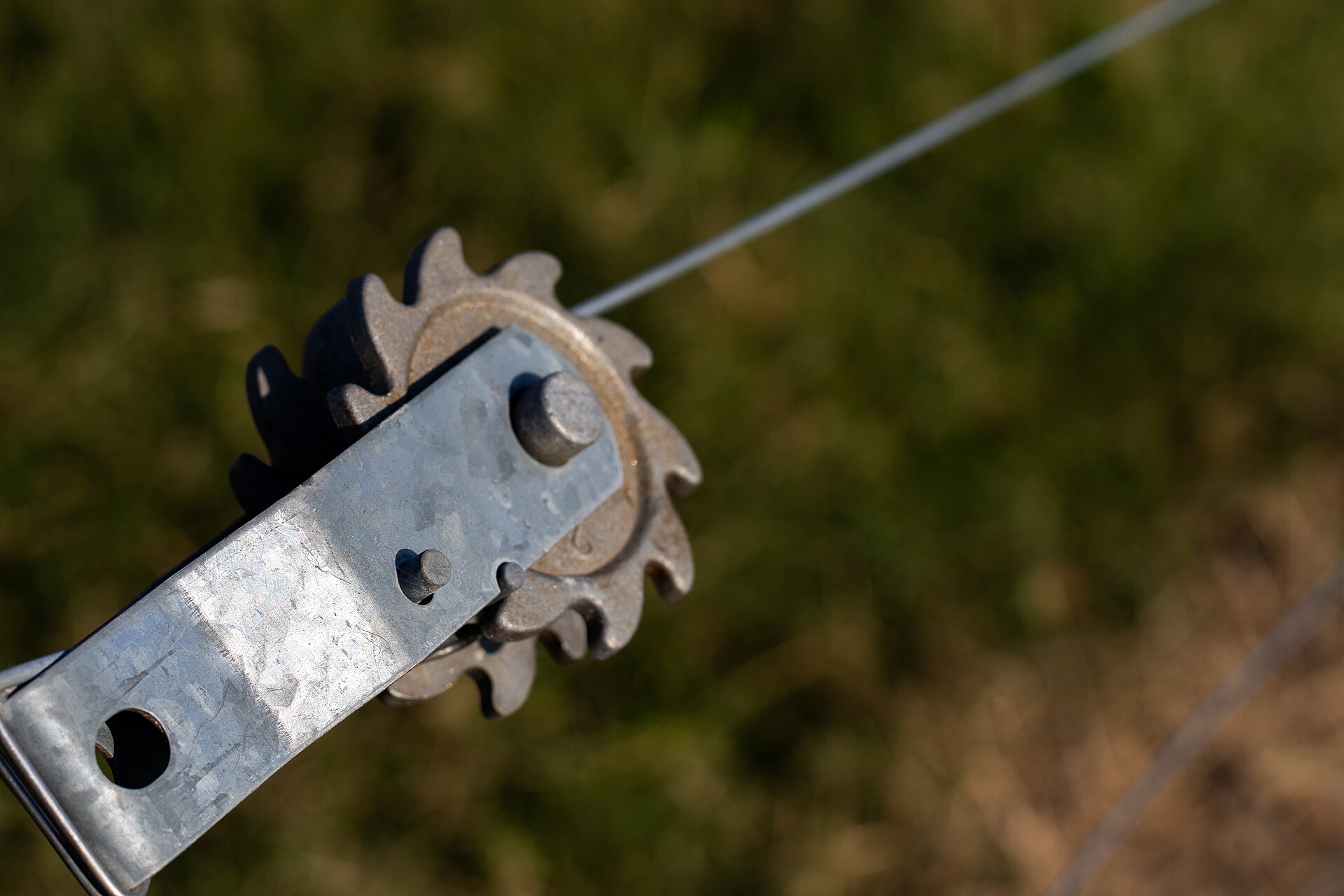
    In-line ratchet strainer tensioning a smooth high-tensile fence wire
    Illustrative — product example, not an S&S Fencing project. Photo: Elizabeth Chamberlain (CC BY 2.0).

    What high-tensile fence is and what it is for

    High-tensile fence is a wire fence built from hard-drawn 12.5 gauge wire tensioned between braced end assemblies, and it is used where long runs, rolling terrain and steady livestock pressure make a conventional soft-wire fence stretch, sag and fail.

    The wire itself is the structural member. Because hard-drawn high-tensile wire carries far more load per strand than soft (low-carbon) wire, a properly tensioned fence resists animal impact by flexing and returning rather than permanently deforming. That is why the same fence line holds its geometry for decades instead of needing to be re-stretched every few seasons.

    • Cattle and stocker operations — perimeter and cross-fencing on long runs.
    • Rotational grazing — permanent electrified lanes with temporary interior divisions.
    • Horse operations — only with coated or high-visibility wire and appropriate spacing; board or woven wire remains the safer choice for turnout and paddocks. See horse farm and equestrian fencing.
    • Large acreage and rough ground — where post counts and material weight decide the budget.

    Not the right fence for small pens, working alleys or high-pressure corrals — those need woven wire or pipe and board.

    Published specifications

    S&S builds high-tensile fence from 12.5 gauge wire rated 179,000–200,000 psi with roughly 1,380–1,535 lb breaking strength, specified in Class 1, Class 3 or Class 40 / Bezinal coating depending on how aggressive the environment is.

    ItemSpecification
    Wire gauge12.5 gauge hard-drawn high-tensile
    Tensile strength179,000–200,000 psi
    Breaking strengthapprox. 1,380–1,535 lb per strand
    Working tension200–250 lb per strand, set with in-line strainers
    Coating — Class 1light zinc; shortest service life, lowest cost
    Coating — Class 3approx. 0.85–1.1 oz/ft² zinc — lasts roughly 3x longer than Class 1
    Coating — Class 40 / Bezinalzinc-aluminum alloy for aggressive, wet or high-ammonia environments
    Line post spacing16–30 ft on level ground; tightened to 8–12 ft on grade changes and curves
    Strand count5–8 strands typical, set by livestock class and electrification
    Brace assemblytwo posts 8 ft apart, 4 ft embedment, horizontal compression member plus diagonal tension wire

    Coating class is the decision that sets service life

    Class 1 and Class 3 wire look identical on the roll. The difference is zinc mass: Class 3 carries roughly 0.85–1.1 oz/ft² and lasts about three times as long as Class 1 in the same conditions. On a fence you intend to keep for 25 years, Class 3 is the only defensible spec. Barn lots, feedlots and anywhere with standing water or heavy ammonia exposure should move up to Class 40 / Bezinal zinc-aluminum.

    Installation method

    A high-tensile fence is only as good as its end assemblies: every corner, end and gate post is built as a braced assembly of two posts 8 ft apart at 4 ft embedment, tied with a horizontal compression member and a diagonal tension wire, before any line wire is pulled.

    We drive posts rather than hand-set them wherever soil allows. A driven post compacts the soil around the shaft instead of sitting in backfill, so it holds tension longer and resists frost heave. See post augering and driving for how we handle rock and hardpan.

    • Layout. Corners and ends first, then the line staked and cleared.
    • Brace assemblies. Horizontal compression member between the two posts, diagonal tension wire running from the base of the brace post to the top of the end post — the diagonal must oppose the pull.
    • Tensioning. In-line strainers on each strand let every wire be tensioned and re-tensioned independently to 200–250 lb without disturbing the others.
    • Terrain following. Line posts tightened through dips and crowns; tie-downs (stays) in dips keep wire from lifting, and a floating brace holds tension over a crown.
    • Water gaps. Creek and drainage crossings get a breakaway or flood-gate section that releases in high water instead of taking the fence line with it.
    • Electrification. Where specified, insulated line posts and a properly grounded energizer — grounding is coordinated so the fence is not carrying stray voltage.

    How high-tensile compares to the alternatives

    High-tensile wire delivers 20–30 years of service at the lowest material cost per foot of any permanent farm fence, but it requires correct bracing and periodic re-tensioning that barbed wire and board fence do not.

    SystemService lifeRelative material costBest for
    High-tensile wire (Class 3)20–30 yearsLowestLong runs, rolling ground, cattle
    Fixed-knot woven wire30–40 yearsMediumMixed livestock, game exclusion, no maintenance appetite
    Barbed wire15–20 yearsLowCattle perimeter on a short budget horizon
    2"x4" no-climb woven wire25–35 yearsHigherHorses, foals, small stock
    Kentucky board fence20–30 years with paintingHighestPresentation, horse turnout, entrances

    Maintenance and expected lifespan

    A Class 3 high-tensile fence installed on correct braces should run 20–30 years, and the maintenance is a walk of the line twice a year plus re-tensioning strainers as needed.

    • Twice a year — walk the line, re-tension any slack strand at the strainer, clear brush off the wire.
    • After storms — check water gaps and reset breakaway sections.
    • Annually — inspect brace assemblies and diagonal wires; a loosened diagonal is the first sign a corner is moving.
    • Electrified lines — check voltage at the far end of the run, not at the energizer.

    S&S installs new fence and full replacements. We do not take on repair work on fences built by others — but every fence we install carries our one-year workmanship warranty and we will come back for warranty items on our own work.

    Total cost of ownership per year of service

    The honest way to compare farm fence is dollars per foot divided by years of service, not the install price — and on that basis Class 3 high-tensile is usually the cheapest permanent fence a Kentucky operation can build.

    A Class 1 fence that costs slightly less up front and lasts a third as long is the most expensive option on the page once you annualize it. The same logic applies to skipping brace assemblies: a fence that loses tension in year three costs a full rebuild.

    Pricing per linear foot depends on terrain, strand count and brace count, so we price the actual line rather than quote a range sight unseen. Call 502-468-1209.

    Warranty and proof

    Every S&S high-tensile installation carries a one-year workmanship warranty, and the company carries General Liability and Workers’ Compensation with COIs issued on request.

    S&S Fencing & Property Maintenance LLC is family-owned and woman-owned, operating since 2015 out of Cox’s Creek in Nelson County, Kentucky. BBB A+ Accredited and Blue Book ProView Verified. Shawn and Shelby Fick walk the projects. See prequalification and contractor credentials.

    Farm references are provided on request. More completed work is in the projects gallery.

    How We Work

    Our Process

    1. Step 1

      Walk the line

      We walk the actual fence line with you, mark corners and ends, and note grade changes, creek crossings and rock.

    2. Step 2

      Specify the fence

      Strand count, coating class, post spacing and electrification are written down before pricing so you know exactly what you are buying.

    3. Step 3

      Build the ends first

      Braced corner, end and gate assemblies go in first — two posts 8 ft apart at 4 ft embedment with compression member and diagonal.

    4. Step 4

      Pull, tension, walk off

      Wire is run, tensioned to spec with in-line strainers, water gaps set, and the whole line walked with the owner.

    Frequently Asked Questions

    High-tensile farm fence uses 12.5 gauge hard-drawn wire rated at 179,000–200,000 psi, with a breaking strength of roughly 1,380 to 1,535 lb per strand. Heavier gauges exist but 12.5 gauge is the standard for livestock perimeter and cross-fencing.
    Class 3 galvanized wire carries roughly 0.85 to 1.1 oz per square foot of zinc and lasts about three times as long as Class 1 in identical conditions. The two look identical on the roll, so the coating class has to be specified in writing. Class 40 or Bezinal zinc-aluminum is the step above for wet, salty or high-ammonia environments.
    Line posts typically run 16 to 30 ft apart on level ground, tightened to 8 to 12 ft through grade changes, curves and dips. The wire carries the load, so post spacing is set by terrain rather than by strength.
    A braced end assembly uses two posts set 8 ft apart at 4 ft of embedment, joined by a horizontal compression member, with a diagonal tension wire running from the base of the brace post to the top of the end post so the diagonal opposes the pull of the fence.
    A Class 3 galvanized high-tensile fence on correctly braced ends lasts 20 to 30 years in Kentucky conditions. Class 1 wire in the same fence line lasts roughly a third as long, which is why coating class matters more than any other single line item.
    No. S&S Fencing installs new fence and full replacements only, plus painting and temporary fence rental. Warranty service is provided on fences S&S installed. Call 502-468-1209 to discuss a new line or a full replacement.

    Send us the drawings and the spec section

    We bid from plans, walk the site, and return a line-item scope. Ask Shawn or Shelby Fick directly at 502-468-1209.

    Also See

    Related Scopes & Documentation

    Family-Owned · Woman-OwnedFully Insured · COIs on Request1-Year Workmanship WarrantyNew Installs & Full ReplacementsFree On-Site Estimates
    BBB Accredited BusinessBlue Book ProView Verified

    Ready for your free fence estimate? Call Shawn & Shelby anytime.