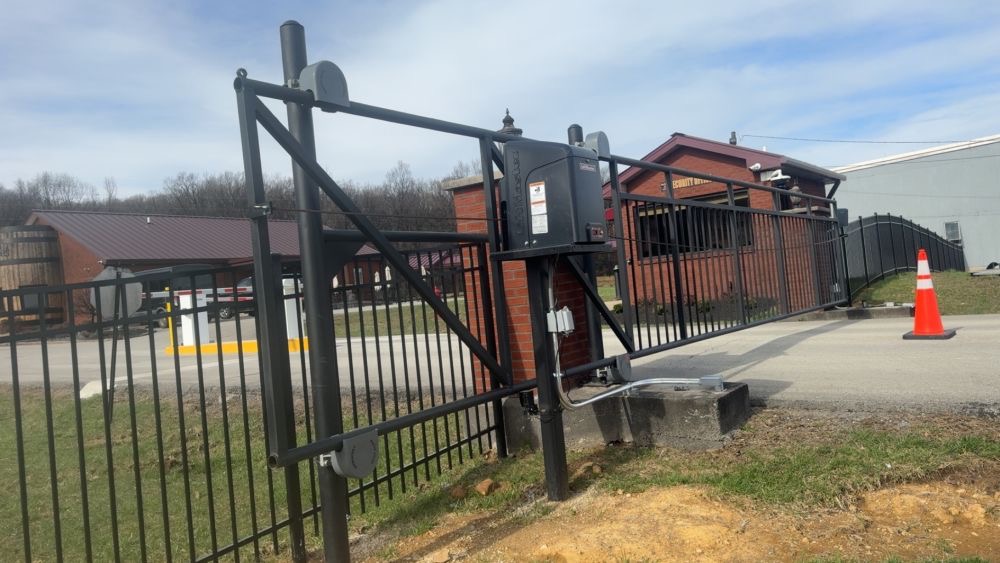
Motorized commercial cantilever gate on LiftMaster operators installed by S&S Fencing at Four Roses Distillery in Cox's Creek, Kentucky

    Gates & Access

    Gate Operators & Access Control

    Operator selection by duty cycle, UL 325 and ASTM F2200 compliance, credential integration and documented annual inspections — for commercial and industrial gates across Kentucky and Southern Indiana.

    • Operating since 2015
    • Family-owned & woman-owned
    • BBB A+ Accredited
    • Blue Book ProView Verified

    General liability and Workers’ Compensation carried — COIs on request. See full prequalification and contractor credentials.

    This page is about the machine; the gate itself is a separate scope

    A powered gate is two purchases: the gate — leaf, frame, track, posts and hardware — and the operator and access-control system that moves and authorizes it. This page covers the operator and controls. The gate structures themselves, including cantilever, swing and custom leaves, are on the commercial gates page.

    We split them out because they fail for different reasons and get specified by different people. A gate leaf fails from geometry, wind and abuse; an operator fails from duty-cycle mismatch, power problems and missing maintenance. Most “bad gate” complaints are actually operator or controls problems on a perfectly good gate.

    • Commercial gates — leaf construction, cantilever and swing geometry, track and hardware.
    • Custom entrances — fabricated ornamental gates, columns and driveway entrances.
    • This page — operators, safety compliance, credentials and ongoing inspection.

    Operator types by duty cycle

    Operator selection is driven by duty cycle first and gate type second. A gate cycling 400 times a day at a distribution center needs a continuous-duty industrial operator; the same gate on a residential-grade unit will burn out inside a year and get propped open in the meantime.

    TypeBest forDuty considerations
    Slide and cantilever operatorsTruck entrances, yards, sites with limited swing roomHighest-cycle application; continuous-duty motor, properly sized clutch or torque limiter, and a gate that rolls freely before power is ever added
    Swing operators (arm, jack, underground)Driveways, entrances, service gates with room to swingLeaf weight, length and wind load govern; long leaves and solid infill drive up torque demand fast
    Vertical liftSites with no side room and no swing roomOverhead structure and clearance needed; higher cost, used where geometry leaves no alternative
    Vertical pivotSloped or rough approaches, snow and debris conditionsNothing on the ground to bind; tolerates grade change better than a slide gate
    Barrier armsParking control, high-volume traffic counting, staffed lanesVery fast cycle, high cycle count — controls traffic, provides no security by itself
    Turnstiles and pedestrian gatesEmployee entrances, stadium and yard pedestrian controlFull-height for secured perimeters, waist-high for supervised areas; free-egress and ADA gate required alongside

    Power and environment matter as much as the model. Available voltage and phase, conduit runs, battery backup for outages, solar where power is genuinely impractical, and heater kits for Kentucky winters are all decided at design rather than discovered at startup.

    UL 325 and ASTM F2200: what compliance actually requires

    UL 325 governs the gate operator and requires the operator class to match the application with both primary and secondary entrapment protection. ASTM F2200 governs the gate itself — its construction, clearances and geometry. A powered gate is only compliant when both are satisfied, and both are verifiable in the field.

    Entrapment protection

    • Primary and secondary means. Two independent means of entrapment protection are required, drawn from inherent sensing (the operator detecting obstruction), contact edges, photo eyes and other non-contact sensors. Two devices of the same type in the same zone do not satisfy the requirement.
    • Every entrapment zone. Slide gates have entrapment zones at both the leading and trailing edges and at the point where the gate passes the post; swing gates have them in both directions of travel and at the hinge. Sensors are placed per zone, not per gate.
    • Signage. Required warning placards on both sides of the gate, plus the operator manual and manual-release instruction left on site.
    • Controls placement. Open and close controls located so the operator of the controls can see the gate, and out of reach where the public could use them.
    • Testing and documentation. Entrapment protection tested at commissioning, with the test recorded. That record is what an insurer, safety officer or plaintiff’s expert asks for.

    ASTM F2200 on the gate structure

    • Slide gates must be plumb and square when closed, with an initial pull force of 40 lbs or less — meaning the gate must roll from a standstill under 40 lbs of applied force. It is the single most useful field check available: if a gate takes real effort to move by hand, the operator is compensating for a mechanical problem and will fail early. This is also the check that most commonly reveals a settled post, a worn roller or a bent track.
    • No exposed rollers, pinch points or protrusions where a person could be caught.
    • Leading edge free of protrusions; no openings that could admit a hand or foot.
    • Positive stops so a slide gate cannot travel off its track or a swing gate over-travel.
    • Vehicle gates not used as pedestrian gates — a separate pedestrian opening is provided.

    What a non-compliant existing gate looks like

    These are the conditions we find most often on existing sites, and any one of them is worth addressing before an incident:

    • Photo eyes missing entirely, unplugged, painted over, knocked out of alignment, or bypassed at the board.
    • One means of entrapment protection instead of two.
    • Warning signage missing or faded past legibility.
    • A slide gate that takes both hands and real effort to move — failing the 40 lb pull-force check.
    • Exposed rollers, a bent or debris-filled track, or a gate riding on a broken wheel.
    • Gaps or openings in the leaf that admit a hand, or hardware protruding from the leading edge.
    • No positive stop, so a slide gate can run off the end of its track.
    • A residential operator running a commercial-duty gate.
    • Pedestrians routinely walking through the vehicle gate because no man-gate exists.
    • No manual release, or a release nobody on site knows how to use.

    Access methods and integrating with your existing system

    Access control decides who gets through and creates the record of it. Keypads, card and fob readers, RFID and long-range tags, vehicle detection loops, video intercom and cellular controllers all work — the real question is whether the gate integrates with the head-end system the owner already runs.

    • Keypad. Lowest cost, no credential to issue, and no meaningful audit trail — codes get shared. Fine for a maintenance yard, weak for anything that needs accountability.
    • Card and fob readers. Individual credentials, revocable, and an event log. The default for employee and tenant access.
    • RFID and long-range tags. Windshield tags or hang tags read at distance so a vehicle never stops. The right answer for high-volume employee and fleet lanes.
    • Vehicle loops and detection. Free-exit loops, safety loops, reversing loops and anti-tailgate arrangements — plus radar or photo-eye alternatives where paving cannot be cut. Loops belong in the paving sequence, not after it.
    • Video intercom. Visitor and delivery handling with a person on the other end, tied to the office or a remote monitoring service.
    • Cellular and app-based controllers. Remote open, credential management and event history without running a network to the gate. Practical on remote sites and small tenants.
    • Head-end integration. Where an owner already runs an access-control platform, the gate is wired as another door on that system rather than as an island with its own credential list. We coordinate dry-contact interfaces, request-to-exit, gate position monitoring and alarm points with the owner’s security integrator and set the conduit and stub-ups they need.
    • Emergency-responder access. Keyed override, key box, radio receiver or manual release per the local fire district’s requirement, verified with the AHJ rather than assumed.
    • Trade coordination. We set gates, posts, sleeves and conduit stubs and coordinate final power and low-voltage terminations with the electrical and security subcontractors.

    Preventive maintenance and documented annual inspections

    A powered gate is the only piece of moving machinery on most commercial sites, and it carries a pinch-point safety system that can drift out of adjustment silently. S&S offers scheduled preventive maintenance with a written inspection record — this is an ongoing service we want to provide, not a line item at the bottom of an install.

    Manufacturers publish maintenance intervals, and safety practice for vehicular gates points to inspection at least annually, more often on high-cycle installations. Insurers and safety auditors increasingly ask to see the record.

    What a scheduled inspection covers

    • Entrapment protection tested in every zone, in both directions of travel, and the result written down.
    • Photo eye alignment, lens condition, wiring and mounting security.
    • Contact edge condition and response.
    • Manual pull-force check on slide gates against the 40 lb requirement.
    • Rollers, wheels, track condition, track debris and positive stops.
    • Hinge, bearing, chain, belt and drive condition; lubrication per the manufacturer.
    • Clutch or torque-limiter setting and inherent-sensing response.
    • Fastener torque, post plumb and footing condition — a settled post is the usual root cause of a struggling gate.
    • Battery backup condition and loss-of-power behavior.
    • Warning signage presence and legibility.
    • Access-control function: reader, loop, intercom, override and manual release, with staff shown how to use the release.
    • Written report with photographs and a list of anything needing attention.

    Retrofit and upgrade of existing operators

    We work on gates we did not install. Common scopes:

    • Bringing an existing powered gate into UL 325 compliance — adding the missing second means of entrapment protection, correcting sensor placement, restoring signage.
    • Replacing an undersized or failed operator with a correctly rated continuous-duty unit.
    • Replacing worn rollers, track, hardware and positive stops, and resetting a settled or leaning post so the gate meets the pull-force requirement again.
    • Adding or upgrading access control — reader, loop, intercom or cellular controller — on an existing operator.
    • Replacing a gate leaf that has been struck, racked or sagged beyond adjustment. Full replacement is often the right call and we will say so rather than keep adjusting a bent frame.
    • Adding battery backup, heater kits or surge protection after an outage or a cold-weather failure.


    Submittals, lead times and how to get priced

    Operators, controls and custom gate leaves are the long-lead items on a fence package, and they are the usual reason a perimeter finishes on time but the entrance does not. Get the operator and controls decided early — well before paving, because loops and conduit have to go in first.

    • Submittal package. Operator cut sheets and class designation, entrapment protection device data, gate construction details, access-control device data, wiring and interface diagrams, and warning signage details.
    • Sequence that saves money. Conduit, sleeves, loop saw cuts and power stub-ups coordinated before paving and concrete. Retrofitting a loop into finished pavement costs more and looks worse than cutting it in the first time.
    • Lead times. Operators, custom leaves and specialty access hardware carry real lead time that varies by manufacturer and configuration. We quote the current lead time at bid and re-confirm at release rather than guessing at a number that will be stale.
    • What we need to price. Opening width, gate type, leaf weight or infill, approach grade, expected daily cycles, available power, the access method you want, whether an existing head-end must be integrated, and the fire district’s override requirement.
    • Closeout. Operator manuals, entrapment-protection test record, programmed credential handover, staff training on manual release, and a 1-year workmanship warranty on our installation — see the warranty page.
    • Where gates show up in our market work: warehouse and distribution, data centers, substations and utilities, high-security perimeters, government and municipal, schools and campuses, athletic facilities, distilleries and rickhouses, solar and utility-scale sites, and horse farms. Credentials are on the credentials page; completed gate work is in the projects gallery.

    How We Work

    Our Process

    1. Step 1

      Site and duty review

      We measure the opening, check approach grade and power, and ask how many cycles a day the gate really sees — that answers the operator class.

    2. Step 2

      Design and submittals

      Operator, entrapment protection devices, access method and head-end interface selected and submitted, with conduit and loop locations coordinated before paving.

    3. Step 3

      Install and commission

      Gate set plumb and rolling freely first, then operator and controls installed, programmed and tested with the electrical and security trades.

    4. Step 4

      Document and maintain

      Entrapment protection test recorded, manuals and credentials turned over, staff trained on manual release, optional annual inspection schedule set.

    Frequently Asked Questions

    UL 325 requires the gate operator class to match the application and requires two independent means of entrapment protection — drawn from inherent obstruction sensing, contact edges, photo eyes and other non-contact sensors — covering every entrapment zone. It also requires warning signage on both sides of the gate, controls positioned so the person operating them can see the gate, and the operator manual and manual-release instructions left on site.
    ASTM F2200 requires a slide gate to be plumb when closed and to have an initial pull force of 40 lbs or less, meaning the gate must begin to roll from a standstill under no more than 40 lbs of applied force. It is the most useful field check available: a gate that takes real effort to move by hand is being compensated for by the operator and will fail early, and the usual root causes are a settled post, a worn roller or a bent or debris-filled track.
    The most common non-compliant conditions are photo eyes that are missing, unplugged, misaligned or bypassed at the board, only one means of entrapment protection instead of two, missing or illegible warning signage, a slide gate that fails the 40 lb pull-force check, exposed rollers or a bent track, no positive stop at the end of travel, a residential-grade operator running a commercial-duty gate, and pedestrians walking through the vehicle gate because no separate man-gate exists.
    At least annually, and more frequently on high-cycle gates such as distribution center truck entrances that cycle hundreds of times a day. An inspection should test entrapment protection in every zone and both directions, check photo eye alignment and contact edges, verify slide-gate pull force, inspect rollers, track, positive stops and drive components, confirm battery backup behavior, and produce a written record with photographs.
    Yes. Where an owner already runs an access-control platform, the gate is wired as another door on that system rather than as an island with a separate credential list, using dry-contact interfaces, request-to-exit, gate position monitoring and alarm points coordinated with the owner's security integrator. S&S sets the gate, posts, sleeves and conduit stubs and coordinates final power and low-voltage terminations with the electrical and security subcontractors.
    Yes. Common scopes include bringing an existing powered gate into UL 325 compliance by adding a missing second means of entrapment protection and correcting sensor placement, replacing an undersized or failed operator with a correctly rated continuous-duty unit, renewing rollers, track and positive stops, resetting a settled post so the gate meets the pull-force requirement, adding access control to an existing operator, and full replacement of a leaf that has been racked or struck beyond adjustment.
    Operators, custom gate leaves and specialty access hardware are manufactured to configuration rather than pulled from local stock, so they carry real lead time that varies by manufacturer and options. They are the usual reason a perimeter finishes on schedule but the entrance does not, which is why operator and control decisions should be made early — loops, conduit and power stub-ups have to be installed before paving and concrete.

    Send us the drawings and the spec section

    We bid from plans, walk the site, and return a line-item scope. Ask Shawn or Shelby Fick directly at 502-468-1209.

    Also See

    Related Scopes & Documentation

    Family-Owned · Woman-OwnedFully Insured · COIs on Request1-Year Workmanship WarrantyNew Installs & Full ReplacementsFree On-Site Estimates
    BBB Accredited BusinessBlue Book ProView Verified

    Ready for your free fence estimate? Call Shawn & Shelby anytime.