

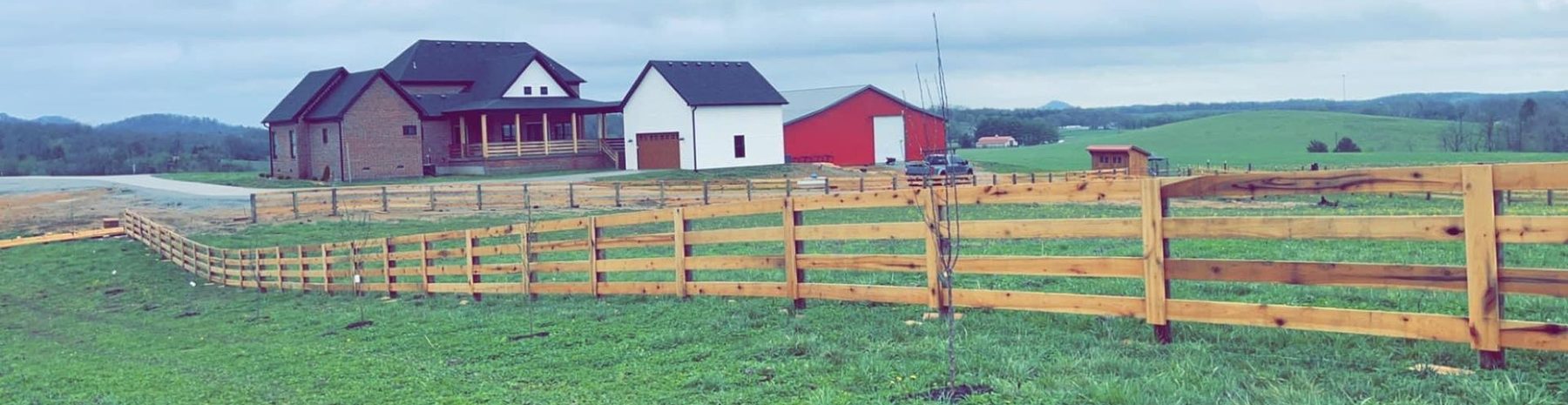
Kentucky four-board plank fence along a horse pasture — S&S Fencing

    Agricultural Markets

    Horse Farm & Equestrian Fencing

    Fence systems specified pasture by pasture — turnout, paddock, stallion, foaling, arena and round pen — with published board and woven wire numbers, gate and lane layout, and an ongoing painting program.

    • Operating since 2015
    • Family-owned & woman-owned
    • BBB A+ Accredited
    • Blue Book ProView Verified

    General liability and Workers’ Compensation carried — COIs on request. See full prequalification and contractor credentials.

    What a working Bluegrass horse farm actually needs

    A working horse farm does not have one fence — it has five or six, because a turnout field, a paddock, a stallion pen, a foaling field, an arena and a round pen each carry a different pressure level and a different consequence when the fence fails.

    Pasture typeTypical sizePressureRecommended system
    Turnout / broodmare field5–40 acresAverage4-board at 54 in, or 2"x4" no-climb with a top board
    Paddock0.5–3 acresMedium to heavy4-board at 54 in with no-climb mesh inside
    Stallion pen0.25–2 acresHeavy5-board at 5–6 ft, mesh-lined, no shared fence lines
    Foaling field2–10 acresMedium — highest consequence2"x4" no-climb full height with top board, no gaps a foal can roll under
    Arena100 x 200 ft typicalLight, high visibilityBoard at 5 ft, kick boards at grade
    Round pen60–70 ft diameterHeavy, short durationSolid board or panel, 5–6 ft

    Shawn Fick grew up in Nelson County farm country and S&S has been building these fences since 2015. If you are building a whole farm from raw ground, we lay out the perimeter, the interior divisions and the lanes together — because the lane layout drives where every gate goes.

    Fence selection by pressure level

    Fence selection on a horse farm should be driven by pressure level — heavy, medium, average or light — because the same fence that is correct on a 40-acre broodmare field is not adequate on a stallion pen and is overbuilt on an arena rail.

    • Heavy pressure — stallions, weaning pens, feed-line fences, anywhere horses are pushed against the fence daily. Specify 5-board at 5–6 ft with 2"x4" mesh behind the boards and end/gate posts at 7–8 in diameter and 4.5–5 ft embedment.
    • Medium pressure — small paddocks, lanes and any fence where two horses can face each other across the line. 4-board at 54 in with mesh on the inside face.
    • Average pressure — general turnout and broodmare fields with adequate acreage. 4-board at 54 in, or 2"x4" no-climb woven wire with a sight board on top.
    • Light pressure — perimeter and boundary lines with no horses directly against them. 3-board, or a high-tensile boundary with coated, high-visibility wire.

    Barbed wire has no place in a horse enclosure at any pressure level. Where a farm inherits a barbed line on an interior division, the correct answer is full replacement — see barbed wire fencing for the honest comparison.

    Published specifications

    S&S publishes the numbers: board fence posts at 6–7 in diameter and 7–8 ft length on 8 ft centers, boards at 1"x6" oak or 1.25"x6" pressure-treated pine in 16 ft lengths, 54 in standard height, and 12 in ground clearance.

    Board fence

    ItemSpecification
    Posts6–7 in diameter, 7–8 ft length, 8 ft centers
    BoardsOak 1"x6" or pressure-treated pine 1.25"x6", 16 ft standard length
    3-board spacing15–16 in on center
    4-board spacing12–14 in on center
    Standard height54 in
    Stallion pens and arenas5–6 ft
    Ground clearance12 in
    Line post embedment4–5 in diameter post, 2.5 ft minimum embedment
    Corner post embedment5–6 in diameter post, 3.5–4 ft embedment
    End / gate post embedment7–8 in diameter post, 4.5–5 ft embedment

    Woven wire for horses

    ItemSpecification
    No-climb mesh2"x4" aperture, 12.5 gauge line wires with 10 gauge top and bottom
    V-mesh2"x4" diamond, 14 gauge vertical / 12.5 gauge horizontal
    CoatingClass 3 galvanized standard; Class 40 / Bezinal in barn lots
    Height — general turnout48–60 in plus sight board
    Height — foaling and small stockFull height to grade, no bottom gap

    Full detail lives on Kentucky board fencing and woven wire fencing.

    Horse safety — visibility, flex, mesh aperture and chew resistance

    A horse-safe fence is one the horse can see from a gallop, that flexes instead of cutting, that has no opening a hoof can pass through, and that does not reward chewing.

    • Visibility. A painted board or a top sight board gives a horse a solid horizontal line to read at speed. Bare wire without a sight board is the most common cause of run-through injuries.
    • Flex and breakaway. Boards fastened to break outward under heavy impact, and properly tensioned mesh that gives and returns, both absorb energy. A rigid, over-braced fence transfers that energy into the animal.
    • 2"x4" aperture. A 2 in by 4 in opening is too small for a hoof to pass through, so a pawing or rolling horse cannot get a leg into the mesh and become entrapped. Larger field-fence and game-fence openings can trap a hoof and are not appropriate for horses.
    • Chew resistance. Oak boards resist chewing better than pine; painted surfaces are less attractive to cribbers; a hot wire on the top line stops chewing where it is a habit.
    • No protrusions. Fasteners set flush, no exposed wire ends, and gate hardware turned away from the horse side.

    Gates, entrances, lanes and alleys

    Gate and lane layout should be designed before the fence line is staked, because gate placement determines how horses and equipment move through the farm — and a badly placed gate is the one thing you cannot fix with better fence.

    • Field gates. 12–16 ft for tractor and hay equipment; 4–6 ft man-gates where handlers move alone.
    • Placement. Gates in corners funnel horses into a pinch point. Set gates back from the corner, on the lane side, so a horse can be turned rather than cornered.
    • Gate posts. 7–8 in diameter at 4.5–5 ft embedment — the heaviest post on the farm, because it carries a swinging load for 25 years.
    • Lanes and alleys. 12–16 ft wide so equipment and a led horse both fit; double-fenced with mesh where horses move past each other.
    • Farm entrances. Custom welded and automated entrances, including the 35 ft cantilever entrance gate S&S installed at Four Roses Distillery in Cox's Creek, Kentucky — see custom entrances and gates.

    Fence painting and maintenance programs

    Paint is what makes a 20-year board fence last 30, so S&S offers fence painting as an ongoing program rather than a one-time add-on — we are one of very few Kentucky fence contractors that installs and paints with its own crews.

    • New installs — first coat applied after the boards have dried down, not the week they go up.
    • Program cadence — a full-coat cycle with a spot-and-touch year in between, set against how your fence is weathering rather than a fixed calendar.
    • Scope options — full farm, road frontage only, or entrance and show-face sections.
    • Scheduled by season — booked in advance so the farm is not competing for a crew in May.

    Details and pricing structure on fence painting and staining. S&S does new installation, full replacement, painting and temporary fence rental — we do not take on repair work on other contractors’ fences.

    Warranty and proof

    Every S&S horse farm installation carries a one-year workmanship warranty, with General Liability and Workers’ Compensation carried and COIs issued on request.

    S&S Fencing & Property Maintenance LLC — family-owned and woman-owned, operating since 2015 from Cox’s Creek in Nelson County. BBB A+ Accredited, Blue Book ProView Verified. Shawn and Shelby Fick are reachable directly at 502-468-1209. Full documentation on the credentials page.

    Farm references are provided on request, matched to the type of line you are putting in. Completed work is in the projects gallery.

    How We Work

    Our Process

    1. Step 1

      Walk the farm

      We walk every pasture with you and record pressure level, pasture use, lane routes and gate positions before any pricing.

    2. Step 2

      Specify by pasture

      Each enclosure gets its own written spec — height, board count, mesh, post diameter and embedment.

    3. Step 3

      Build ends and drive posts

      Corner, end and gate assemblies first at full embedment; line posts driven for compacted holding power.

    4. Step 4

      Paint and program

      Boards painted or stained once dried down, then the farm is put on a scheduled repaint cadence.

    Frequently Asked Questions

    Standard horse fence is 54 in tall. Stallion pens, arenas and any enclosure where horses are pushed against the line should be 5 to 6 ft. Ground clearance of about 12 in keeps a hoof from being caught under the bottom board while still discouraging a horse from rolling under.
    Four-board fence is spaced 12 to 14 in on center and three-board fence is spaced 15 to 16 in on center. Tighter four-board spacing is what keeps a foal from putting its head through the fence and is the standard for paddocks and foaling fields.
    A 2 in by 4 in opening is too small for a hoof to pass through, so a horse that paws or rolls at the fence cannot get a leg into the mesh and become entrapped. Larger field-fence and game-fence apertures can trap a hoof and cause serious injury, so they should not be used in horse enclosures.
    Line posts of 4 to 5 in diameter are set at a minimum of 2.5 ft embedment, corner posts of 5 to 6 in diameter at 3.5 to 4 ft, and end or gate posts of 7 to 8 in diameter at 4.5 to 5 ft. Gate posts carry a swinging load for the life of the fence, which is why they are the heaviest and deepest on the farm.
    Farm lanes and alleys should be 12 to 16 ft wide so tractors, hay equipment and a led horse all fit. Field gates are typically 12 to 16 ft for equipment access with 4 to 6 ft man-gates where handlers move on foot. Gates should be set back from corners so horses can be turned instead of cornered.
    Paint is the single biggest factor in whether a board fence reaches 30 years, and most Bluegrass farms run a full repaint cycle with a spot-and-touch year in between. S&S offers painting as a scheduled ongoing program with its own crews rather than a one-time add-on.

    Send us the drawings and the spec section

    We bid from plans, walk the site, and return a line-item scope. Ask Shawn or Shelby Fick directly at 502-468-1209.

    Also See

    Related Scopes & Documentation

    Family-Owned · Woman-OwnedFully Insured · COIs on Request1-Year Workmanship WarrantyNew Installs & Full ReplacementsFree On-Site Estimates
    BBB Accredited BusinessBlue Book ProView Verified

    Ready for your free fence estimate? Call Shawn & Shelby anytime.