

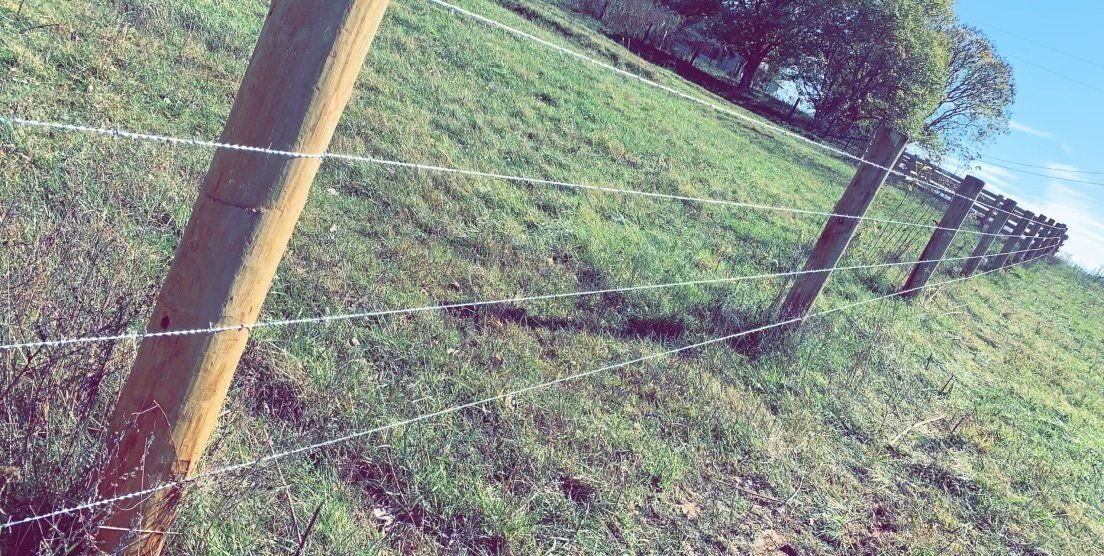
Barbed wire pasture fence on a Kentucky cattle farm — S&S Fencing

    Agricultural Markets

    Cattle & Livestock Fencing

    Published specifications and system selection for cow-calf, stocker, rotational grazing and working-pen fence — including the migration argument from barbed wire to fixed-knot woven wire.

    • Operating since 2015
    • Family-owned & woman-owned
    • BBB A+ Accredited
    • Blue Book ProView Verified

    General liability and Workers’ Compensation carried — COIs on request. See full prequalification and contractor credentials.

    The case for moving from barbed wire to fixed-knot

    Barbed wire lasts 15–20 years and fixed-knot woven wire lasts 30–40, so a fence line rebuilt in barbed wire will be rebuilt twice inside the service life of a single fixed-knot fence — which is the entire argument for migrating perimeter lines as they come due.

    We are not telling anyone to tear out serviceable barbed wire. The decision point is the line that is already failing. At that moment the choice is not “cheap fence or expensive fence” — it is one rebuild or two, plus twenty years of walking the line, plus the calves that get out.

    • Containment. Barbed wire contains adult cattle. Fixed-knot contains calves, and it contains them without injury.
    • Predators. Barbed wire stops nothing. 6 in or 3 in stay spacing does.
    • Mixed stock. Adding goats, sheep or horses to a barbed line means rebuilding it anyway.
    • Labor. A stretched fixed-knot fence does not need annual re-stretching.

    Specifications for both are published on fixed-knot and game fence and barbed wire fencing.

    Coating class — the spec nobody publishes

    Coating class sets how long a wire fence lasts: Class 3 galvanized carries roughly 0.85–1.1 oz/ft² of zinc and lasts about three times as long as Class 1, and Class 40 / Bezinal zinc-aluminum is specified where conditions are aggressive.

    CoatingZinc massRelative lifeWhere to specify it
    Class 1LightBaselineShort-horizon or temporary lines only
    Class 3approx. 0.85–1.1 oz/ft²approx. 3x Class 1Standard for all permanent pasture perimeter
    Class 40 / BezinalZinc-aluminum alloyLongestBarn lots, feed lines, corrals, wet ground, high ammonia

    Class 1 and Class 3 wire are visually identical. If a bid does not state the coating class, it is not a comparable bid. S&S writes the class into the scope.

    Systems by operation type

    The right fence depends on how the ground is used: cow-calf perimeter, stocker turnover, rotational grazing lanes and working pens each call for a different system.

    OperationRecommended systemHeightNotes
    Cow-calfFixed-knot woven wire, 6 in stays low / graduated49 inHolds calves; no injury from barbs at calving
    Stocker / backgroundingFixed-knot 49 in, or 5–6 strand high-tensile electrified49–54 inHigh turnover, heavy pressure at water and feed
    Rotational grazingPermanent high-tensile perimeter and lanes, temporary interior5–8 strandsLane fencing and water access decide the layout
    Bull pastureFixed-knot at 54–60 in with hot top wire54–60 inNever a shared fence line between bulls
    Corral / working pensPipe, panel or heavy board on 8 in posts60 in+Sized for crowding load, not containment
    Mixed sheep and goatsFixed-knot with 3–6 in stays49 inStay spacing is the whole spec

    Published specifications

    Standard S&S livestock perimeter is 49 in fixed-knot woven wire with 9 horizontal 12.5 gauge wires in Class 3 galvanizing, on braced end assemblies of two posts 8 ft apart at 4 ft embedment.

    ItemSpecification
    Wire12.5 gauge high-tensile, 179,000–200,000 psi, approx. 1,380–1,535 lb breaking strength
    Height — general cattle49 in
    Height — bulls / heavy stock54–60 in
    Stay spacing12 in cattle · 6 in mixed stock · 3 in predator exclusion
    Barbed wire alternative4–5 strands cattle at 10–12 in spacing; 15–20 year life
    Line post spacing12–20 ft woven wire · 16–30 ft high-tensile, tightened on grade
    Brace assemblytwo posts 8 ft apart, 4 ft embedment, compression member plus diagonal tension wire
    Roll length330 ft
    CoatingClass 3 standard; Class 40 / Bezinal at barn lots and feed lines

    Common mistakes

    Most failed cattle fence in Kentucky fails for one of six reasons, and five of them are decided before a single roll of wire is pulled.

    MistakeWhat it costsThe fix
    Unbraced or under-braced endsWhole line loses tension in 2–4 yearsTwo posts 8 ft apart, 4 ft embedment, diagonal opposing the pull
    Unspecified coating classClass 1 wire fails at a third of expected lifeWrite Class 3 into the scope
    Hand-set posts in backfillFrost heave and looseningDrive posts so soil compacts around the shaft
    Hinge-joint wire on high pressureMesh bags and stays pivot permanentlyFixed-knot construction
    Post spacing not tightened on gradeWire lifts in dips, sags over crowns8–12 ft spacing plus tie-downs through terrain changes
    No water gapOne flood takes out hundreds of feetBreakaway flood-gate panels at every crossing

    Installation, maintenance and expected lifespan

    S&S drives posts rather than hand-setting them, builds every corner and end as a full braced assembly, and hands over a Class 3 fixed-knot fence that should run 30–40 years on an annual walk.

    • Layout and clearing — line cleared, corners and crossings identified first. Land clearing and grading available via skid loader services.
    • Braced ends and driven posts — see post augering and driving for rock and hardpan.
    • Stretching — full-height stretcher bar so tension is even top to bottom.
    • Maintenance — annual walk, brush clearing, brace inspection; high-tensile lines re-tensioned at the strainers.
    • Lifespan — fixed-knot 30–40 years, high-tensile 20–30, barbed wire 15–20.

    S&S installs new fence and full replacements, plus painting and temporary fence rental. We do not take on repairs to fences installed by others; warranty service applies to our own work.

    Total cost of ownership and warranty

    Judged on cost per year of service rather than cost per foot, Class 3 fixed-knot is normally the cheapest permanent livestock perimeter available in Kentucky — and every S&S install carries a one-year workmanship warranty.

    Two barbed rebuilds inside 40 years, plus twenty years of re-stretching labor and escaped stock, costs more than one correctly braced fixed-knot fence. That is the calculation to run before comparing per-foot numbers.

    Pricing is quoted per linear foot after the line is walked, because terrain, clearing and brace count move the number more than the wire choice does. Call 502-468-1209 for a walked estimate.

    S&S Fencing & Property Maintenance LLC is family-owned and woman-owned, operating since 2015 out of Cox’s Creek, Nelson County. BBB A+ Accredited, Blue Book ProView Verified, General Liability and Workers’ Compensation carried with COIs on request — see credentials.

    Farm references are available on request. Work in progress and completed lines are in the projects gallery.

    How We Work

    Our Process

    1. Step 1

      Walk the ground

      We walk the line, note crossings, rock, water sources and where cattle actually push on the fence.

    2. Step 2

      Specify in writing

      Height, stay spacing, coating class, strand count and post spacing written into the scope so bids are comparable.

    3. Step 3

      Brace, drive, stretch

      Braced ends first, posts driven, wire stretched full-height and water gaps built as breakaway panels.

    4. Step 4

      Walk it off together

      Final walk with the owner, gate operation checked, and a one-year workmanship warranty on the install.

    Frequently Asked Questions

    General cattle fence is 49 in tall. Bulls and heavy stock should be fenced at 54 to 60 in, usually with a hot top wire. Working pens and corrals are built at 60 in or more because they are sized for crowding load rather than containment.
    Four to five strands spaced 10 to 12 in apart is standard for adult cattle. Barbed wire has a service life of 15 to 20 years and does not reliably contain calves, which is why fixed-knot woven wire is the better choice on any line being rebuilt for the long term.
    Over a 40-year horizon, yes. Fixed-knot woven wire lasts 30 to 40 years against 15 to 20 for barbed wire, so barbed wire is rebuilt twice in the same period. Add annual re-stretching labor and escaped stock and the annualized cost of fixed-knot is lower.
    Class 3 galvanized should be the default for permanent pasture fence — it carries roughly 0.85 to 1.1 oz per square foot of zinc and lasts about three times as long as Class 1. Barn lots, feed lines and wet ground should step up to Class 40 or Bezinal zinc-aluminum coating.
    Almost always because the end and corner assemblies were under-built. A correct braced assembly is two posts 8 ft apart at 4 ft of embedment with a horizontal compression member and a diagonal tension wire running from the base of the brace post to the top of the end post. Without that geometry the corner walks and the whole line goes slack.
    Yes. Working pens and corrals are built from pipe, panel or heavy board on 8 in posts at 60 in or taller, sized for crowding pressure. Call 502-468-1209 to walk the layout.

    Send us the drawings and the spec section

    We bid from plans, walk the site, and return a line-item scope. Ask Shawn or Shelby Fick directly at 502-468-1209.

    Also See

    Related Scopes & Documentation

    Family-Owned · Woman-OwnedFully Insured · COIs on Request1-Year Workmanship WarrantyNew Installs & Full ReplacementsFree On-Site Estimates
    BBB Accredited BusinessBlue Book ProView Verified

    Ready for your free fence estimate? Call Shawn & Shelby anytime.